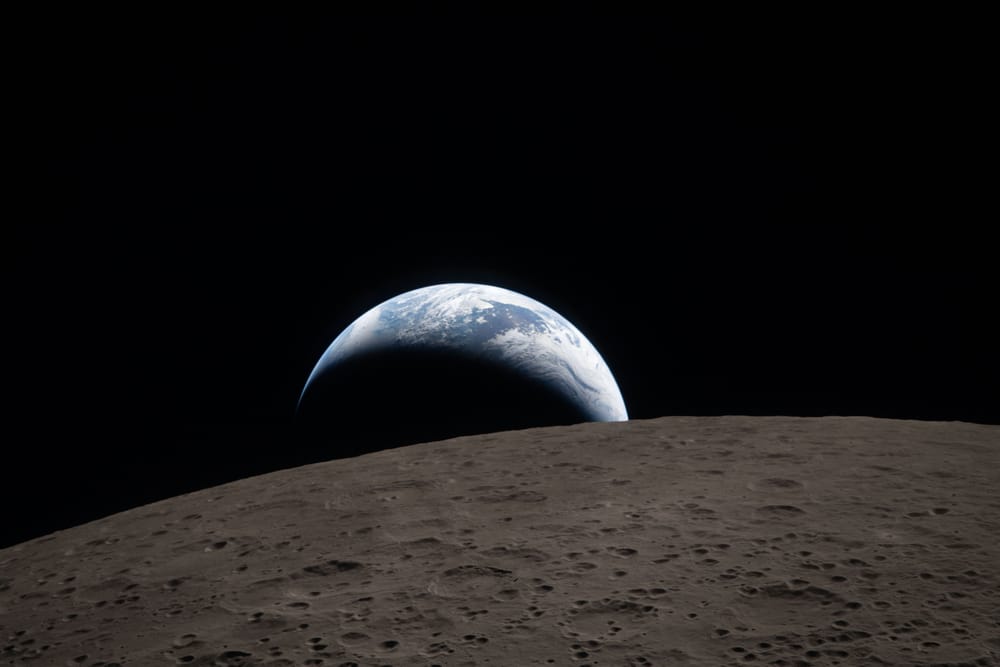
Wondering if this is how people felt back in 1968, when humans first went around the Moon—because watching it happen again today, 58 years later, it certainly feels like the first time. The last time anyone was out there was Apollo 17, in December 1972.
RetroFun.PL is not only about retro computers but about the evolution of technology and finding parallels and connections to our reality today as well, so this is a perfect opportunity to reflect on that.
On December 24th, 1968, three astronauts aboard Apollo 8 became the first humans to orbit the Moon. That Christmas Eve, one in four people on Earth—roughly a billion souls spread across 64 countries—tuned in to watch a grainy, black-and-white broadcast from lunar orbit. Walter Cronkite, not exactly a man given to sentimentality, later admitted he had tears in his eyes. Among the thousands of letters the crew received upon their return, one stood out: "Thank you. You saved 1968."
Today, April 10th, 2026, four astronauts aboard the Orion spacecraft are heading home after completing humanity's first return to the Moon since Apollo 17 in 1972. Splashdown is scheduled for tonight. And most people I talk to don't even know it's happening.
The computer that took us there—and the one bringing us back
The Apollo Guidance Computer was a marvel. Assembled by hand using rope memory—literally woven by women in a Raytheon factory—it packed 74 kilobytes of ROM and 4 kilobytes of RAM—and those are generous conversions from 15-bit words, mind you. It ran at 0.043 MHz. For context, a cheap digital watch today has more processing power. And yet, when Apollo 8 reached the Moon, the AGC's navigation agreed with NASA's ground tracking to within 2.5 kilometers. On the entire return trip, only a single course correction was needed. Not bad for a machine with less memory than the average email signature image.
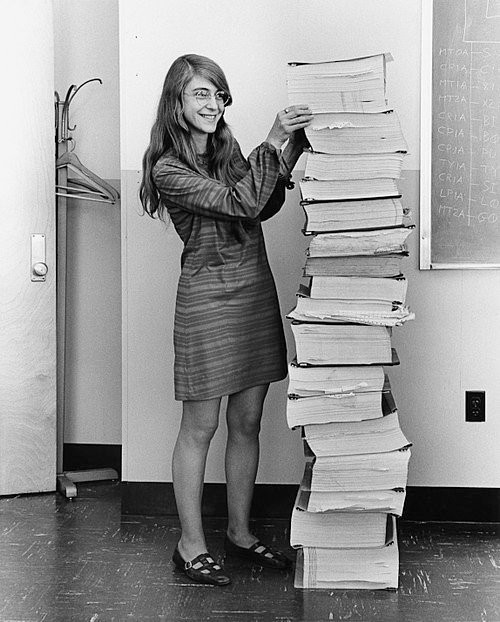
The famous photo of the source code listings printed out of the software written for the Apollo guidance system by Margaret Hamilton and her team reminds us that even kilobytes of source code—despite what you may think—don't mean it's not a lot. Margaret Elaine Heafield, born August 17, 1936, was the lead software designer of the team, and I strongly believe that her approach to designing software showed great understanding of forward-thinking and—as we call it today—user experience design. Many of the decisions she made back in the sixties are solving problems that happen daily with software today, some of which I find infuriating.
Example: During the Apollo 11 landing, three minutes before touchdown, the AGC started throwing 1202 and 1201 alarms — "executive overflow." The cause? The rendezvous radar, left on standby in case of an abort, was flooding the computer with spurious data. The radar's timing reference was frequency-locked but not phase-locked with the computer's clock, causing tiny phase variations that made the hardware think the antenna was rapidly moving when it was completely still. These phantom movements stole CPU cycles in a rapid, steady stream, pushing the AGC past its limits.
This is where Hamilton's design philosophy saved the mission. The software used priority-based scheduling—it knew which jobs were essential for landing (steering, engine control) and which were not. When the overflow hit, the AGC automatically shed lower-priority tasks to keep the critical guidance running. The famous "priority displays" interrupted the astronauts not to say "we're crashing" but to say "I'm dropping non-essential work to keep you alive."
Hamilton's insight, partly inspired by watching her young daughter press random keys on a DSKY prototype and trigger unexpected commands: always assume the unexpected will happen. Her solution for the crew? "If you see a priority display, count to five before acting." This simple rule, if it were implemented and enforced in modern focus-stealing popup windows with unexpected messages—as it is easy to do today—would also prevent us, the computer users, from accidentally choosing an option in a suddenly appearing window without even having a chance to read it, leading to further unexpected consequences.
How many times have you—as I certainly have—pressed something in an unexpected window just because it popped up while you were already typing? Yet here we are, 60 years later, seemingly unable to solve the problem.
But back to the hardware. The Orion spacecraft carrying the Artemis II crew? Its flight computers have 128,000 times more memory and are 20,000 times faster. It runs eight CPUs in parallel, organized in redundant pairs—the same architecture as a Boeing 787, ruggedized for deep space radiation (it can cause random memory and signal bits to flip, certainly not a situation you want when approaching home at roughly 40,000 km/h). Where Apollo had one computer and a prayer, Orion has four redundant systems ensuring that even multiple failures won't compromise the mission. Where Apollo relied on physical switches, relays, and human judgment for critical systems, Orion is computer-controlled end-to-end, with manual overrides only for extreme emergencies.
The difference is staggering. And yet the fundamental challenge is the same: keep fragile humans alive in the void, fling them around a rock 400,000 kilometers away, and bring them home. The engineering got better. The physics didn't get easier.
Fifty-four years of silence
Here's what gets me, though. Between Apollo 17 in December 1972 and Artemis II launching on April 1st, 2026, no human traveled beyond low Earth orbit. Fifty-four years. More than half a century. We went from the Wright Brothers' first flight to supersonic jets in less time than it took us to go back to the Moon after we'd already been there.
It wasn't because we forgot how. It wasn't because the technology wasn't ready—clearly, it was ready in 1968 with rope memory and kilobytes. It was because, as a civilization, we collectively decided it wasn't a priority. Budgets were redirected. Ambitions were scaled back. Administrations changed, and with them, the direction of what was once the most daring human endeavor. The moon became something your parents talked about. A retro achievement. Filed somewhere between bell-bottoms and 8-track tapes. A memory of neighbors visiting your house as the only TV owner in the neighborhood.
And even now, the silence is loud
What strikes me most about Artemis II isn't the technology gap—it's the attention gap. In 1968, a quarter of the planet watched Apollo 8. Today, NASA streams the mission on NASA+, Amazon Prime, Apple TV, Hulu, Netflix, HBO Max, YouTube, and Roku—it's available on more platforms than most Netflix shows—and yet I'd wager most people scrolled right past it. The crew just set a record for the farthest distance any human has traveled from Earth—406,728 kilometeers, beating the Apollo 13 record—and it barely dented the news cycle.
Consider this: Jeremy Hansen just became the first Canadian in deep space — the first non-American ever to go beyond low Earth orbit. The Globe and Mail ran the launch on its front page. PM Carney is scheduled to speak with Hansen after splashdown. But from what I can find, it's not exactly wall-to-wall "CANADA GOES TO THE MOON" coverage. A Canadian becomes the first person who isn't American to leave Earth's neighborhood, and it's competing for attention with... everything else.
There's something beautifully retro about that, in a sad way. We built the future those 1968 engineers dreamed of. We have the computers, the materials, the redundancy, and the streaming infrastructure to beam it into every pocket on the planet. And somehow, going around the Moon became... routine? Before we even did it again?
Maybe that's the real parallel. In 1968, someone wrote "You saved 1968" to three astronauts. I wonder what we'll write to these four. If we notice them at all.
Sources:
- Apollo 11's "1202 Alarm" Explained - Apollo11Space
- Apollo Guidance Computer - Wikipedia
- Exegesis of the 1201 and 1202 Alarms - ibiblio.org
- Apollo 8 Christmas Eve Broadcast - Popular Science
- How Apollo 8 Delivered Christmas Eve Peace - Smithsonian
- Broadcasting Apollo 8 Live From Space - Smithsonian Air & Space
- Apollo Guidance Computer and the First Silicon Chips - Smithsonian Air & Space
- Comparing Computers in Apollo, Artemis Missions - EE Times
- Apollo to Artemis - NASA
- Artemis II Flight Day 6: Lunar Flyby Updates - NASA
- Artemis II: NASA's First Crewed Lunar Flyby in 50 Years - NASA
- Jeremy R. Hansen: First Canadian in Deep Space - Smithsonian Air & Space
- Artemis II crew will endure 3,000°C on re-entry - Phys.org